
Scaling Learning Operations at Sonos
From product-specific learning needs to enterprise LMS governance and operations
My work with the learning platform began within Product Development. As Process & Training Lead, I conducted a needs assessment across the Product Development organization to understand learning, process, and platform requirements. I translated those findings into functional requirements, evaluated potential solutions against those needs, and became the administrator responsible for supporting the platform within Product Development.
Later, when I moved into Learning & Development, my scope expanded from supporting Product Development to owning much of the operating environment behind enterprise learning, including LMS governance, administrative processes, vendor management, administrator support, enterprise onboarding, and global compliance.
Selected materials have been reconstructed for portfolio purposes. Proprietary company information, system data, and internal documentation have been removed or modified.
Project Snapshot
Organization
Sonos
Learning Operations · Learning Technology · Governance · Vendor Management
Focus
Process & Training Lead → Learning & Development Lead
Roles
Product Development → Enterprise Learning Operations
Scope
Scale at a Glance
How the Work Evolved
-
Business Needs
Understand Product Development requirements
-
Platform Requirements
Translate those needs into evaluation criteria
-
Functional Administration
Put the platform to work for Product Development
-
Enterprise Ownership
Own governance, operations, vendor management, and administrator support
-
Sustainable Operations
Build repeatable processes that allow learning to scale
My relationship with the LMS changed as my role changed. I first experienced it as a business stakeholder and functional administrator. Later, I became responsible for much of the operating structure that enabled others to use it effectively.
Product Development was introducing new tools, refreshing core processes, and building greater consistency around quality practices. Learning needed to support employees in applying those changes in their actual roles.
At the same time, Sonos was evaluating learning-platform solutions more broadly.
As Process & Training Lead, I participated in the larger project from the perspective of Product Development.
Starting With the Business
My contribution:
Defined learning-platform requirements for Product Development
Evaluated potential solutions against those requirements
Represented Product Development needs within the broader selection effort
Became the functional LMS administrator supporting the organization
Built role-based learning connected to real tools, processes, and expectations
Supported approximately 800 Product Development employees
I translated the needs of a complex business function into platform requirements, evaluated solutions through that lens, and then operationalized the platform for Product Development.
Learning Connected to the Work
These examples show how learning was tied directly to tools, processes, and expectations inside Product Development:
-
Preparing employees to work differently
As part of the Global PMO, I supported the Jama Requirements go-live by developing role-based learning that prepared Product Development employees to use the new tool and apply the requirements-management practices connected to it.
-
Supporting growth through quality and continuous improvement
Quality Champions were employees recognized by executive leadership for going above and beyond in support of quality and continuous improvement. The community extended beyond Product Development and included employees from HR, Finance, Sales, Customer Service, Marketing, and other areas of the business.
I designed a quarterly learning program to support their continued growth, strengthen continuous-improvement capability, and give the community practical tools they could apply across their work. I also coached subject-matter experts to deliver the training, helping them translate their expertise into clear, engaging learning for the broader group.
-
Strengthening quality, consistency, and process ownership
In partnership with the project manager, I developed a communication and enablement plan to help the Product Development organization adopt the redesigned process and strengthen quality and consistency across Sonos products.
I also owned governance for the detailed development process checklists. When updates were needed, I ensured each change was documented, communicated to the organization, and assigned to a clear process owner so the guidance stayed current and accountability remained visible.
Technology alone was not enough.
Working as both a business stakeholder and functional administrator made something increasingly clear.
A learning platform could provide the infrastructure, but effective learning operations also required:
Ownership
Who is responsible for what?
Governance
What standards guide how the platform is used?
Processes
How does a learning need move from request to delivery?
Permissions
Who needs access, and at what level?
Support
How do administrators and super users get help?
Consistency
How can different functions use one platform without creating unnecessary complexity?
When my role expanded into enterprise Learning & Development, these questions became the foundation for how I approached learning operations at scale.
From Functional Administrator to Enterprise Learning & Development
When I moved into Learning & Development, my perspective expanded.
The question was no longer simply:
How do we make the platform work for Product Development?
It became:
How do we make the learning environment work well across the organization?
Functional View
Product Development
- Define business requirements
- Build role-based learning
- Administer the platform
- Support functional initiatives
- Represent Product Development needs
Enterprise View
Learning & Development
- Own LMS operations
- Establish governance
- Define administrative processes
- Manage roles and permissions
- Manage the vendor relationship
- Support functional administrators and super users
- Support global compliance and enterprise onboarding
- Document processes and standards
- Improve platform operations over time
Building the Operating Foundation
The work behind the learning experience
Supporting Learning Across the Business
Functions Supported
My work supported learning needs across a broad range of business functions and enterprise programs.
Finance
Sales
Legal
IT
HR
Customer Services
Marketing
Product Development
Within Product Development: Software · Hardware · Exploration · UX · Operations
Enterprise Programs
In addition to supporting learning across business functions, I also held direct operational responsibility for several enterprise-wide programs.
Global Compliance
Operational delivery and administration of enterprise compliance learning.
Enterprise Onboarding
Learning infrastructure and administration supporting new-hire onboarding.
Product Development Onboarding
Role-based learning supporting processes, tools, quality practices, and job expectations.
From Manual Assignment to Automated Enrollment
BEFORE
Manual assignment and tracking
Enterprise onboarding was manually assigned based on employee region and relied on manual tracking. This created recurring administrative work and depended on someone placing each employee into the correct learning.
WHAT I CHANGED
A rules-based enrollment process
I redesigned the process using existing LMS functionality:
Automatic Groups
Organized employees based on defined criteria.
Enrollment Rules
Triggered the appropriate learning automatically.
Learning Paths
Structured the onboarding experience.
Region-Based Logic
Routed employees into the appropriate learning based on location.
AFTER
More consistent, rules-based enrollment
New employees could be routed into the appropriate onboarding experience automatically based on defined criteria rather than repeated manual assignment and tracking.
Enterprise onboarding moved from a manually managed assignment process to a rules-based model that improved consistency and reduced the need for manual intervention.
-
Employee Data
Employee attributes, including region and role type, provide the criteria used for routing.
-
Automatic Group
Employees are grouped based on defined attributes, such as region and whether they are people managers or individual contributors.
-
Enrollment Rule
The system automatically triggers the appropriate learning based on those group criteria.
-
Learning Path
Employees are placed into the onboarding experience that matches their role and region.
How I Approached Learning Operations
-
Business Need
-
Learning Requirements
-
Platform & Process Design
-
Delivery
-
Administration & Support
-
Data & Feedback
-
Improvement
The LMS was part of the learning ecosystem, not the learning strategy itself.
Evidence of Scale & Operational Improvement
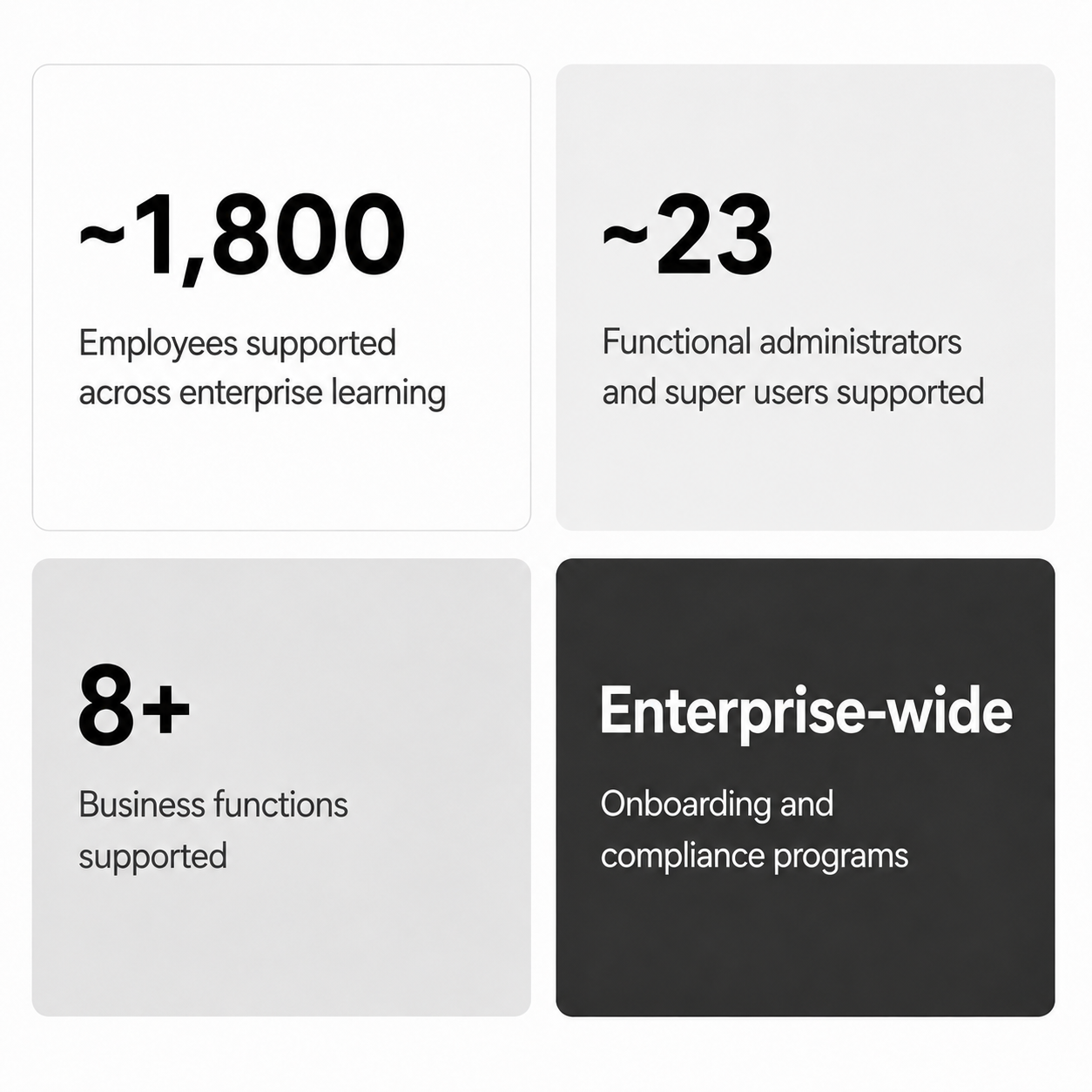
~800 to 1,800 EMPLOYEES
Supported learning across Product Development before my scope expanded into enterprise Learning & Development.
~23 ADMINISTRATORS & SUPER USERS
Supported approximately 8 functional administrators and 15 super users through platform coaching, communications, troubleshooting, and ongoing support.
8+ BUSINESS FUNCTIONS
Supported learning needs across Finance, Legal, HR, Marketing, Sales, IT, Customer Service, and Product Development.
ENTERPRISE PROGRAMS
Held operational responsibility across global compliance, enterprise onboarding, and Product Development onboarding.
AUTOMATED ONBOARDING
Moved regional and role-based onboarding assignment from a manual process to automated groups, enrollment rules, and learning paths.
My Role & Contribution
As Process & Training Lead
I directly owned or led:
Product Development learning-platform requirements
Evaluation of solutions against Product Development requirements
Functional LMS administration
Role-based learning for Product Development initiatives
Product Development onboarding and learning experiences
I contributed to the broader enterprise LMS evaluation and project effort.
As Learning & Development Lead
My scope expanded to include:
LMS ownership, operations, and governance
Administrative processes, roles, and permissions
Global compliance and enterprise onboarding operations
Functional administrator and super-user support
Vendor relationship and platform management
Documentation, SOPs, troubleshooting, and optimization
Three perspectives shaped how I approach learning technology today.
01 · BUSINESS STAKEHOLDER
What does the organization actually need?
I learned to evaluate learning technology through the needs of the business and the work employees were expected to do.
02 · FUNCTIONAL ADMINISTRATOR
What does it take to make the platform useful in practice?
I experienced the day-to-day realities of administering learning, building role-based experiences, supporting users, and translating business needs into platform functionality.
03 · ENTERPRISE LEARNING OPERATIONS LEAD
What makes the learning environment work at scale?
My focus expanded to governance, processes, permissions, vendor management, administrator enablement, automation, and enterprise learning operations.
What this experience reinforced for me
Start with the work, not the technology.
The business need, the work people need to do, and the capabilities required should shape the learning approach and the technology that supports it.
A shared administration model needs structure.
Functional administrators and super users bring learning closer to the business, but they also need clear expectations, communication, support, and shared practices.
Technology needs an operating model.
Features alone do not create sustainable learning operations. Ownership, governance, processes, permissions, and support matter just as much.
Automate where it makes sense.
Good system design can remove repetitive administrative work while improving consistency for the learner.
Technology should support the learning strategy.
Learning technology can help organize and scale learning, but it does not replace practice, manager reinforcement, performance support, or human judgment.