
Enabling an SAP Transformation Across North American Operations
Translating global strategy into local execution, governed system access, and employee capability.
Selected materials have been reconstructed for portfolio purposes. Proprietary company information, system data, and internal documentation have been removed or modified.
Project Snapshot
Organization
Danone North America
Transformation
SAP transformation
Role
Business Change Manager, Global Transformation Team
Scope
North American implementation
The Business Challenge
A global transformation had to work in very different local realities.
Danone was implementing SAP across its operations, replacing ERP systems that employees at many locations already knew how to use.
The transformation required more than configuring technology. Employees needed the correct SAP access to perform their future-state responsibilities, that access had to comply with global security standards, and teams needed enough familiarity with SAP to work confidently in a system that was new to them.
At the same time, the global transformation strategy had to translate into practical execution across individual facilities, each with different roles, processes, and staffing realities.
-
Global Transformation Strategy
-
System + Governance Requirements
-
Local Execution + Employee Capability
My Role in the Transformation
Working at the intersection of strategy, governance, technology, and adoption
As a member of Danone's Global Transformation Team, I supported the North American implementation. My role connected several parts of the program that could not operate independently:
Business Change Manager
-
Global Strategy
Translate transformation priorities into actionable direction for local teams.
-
Business Requirements
Understand what employees would need to do differently in the future-state environment.
-
SAP Security & Governance
Translate responsibilities into appropriate T-code and authorization access while meeting global security requirements.
-
Learning & Adoption
Help employees build foundational capability in SAP and support the teams responsible for delivering the transformation.
Translating Global Strategy Into Local Execution
Global Strategy
As part of the Global Transformation Team, I served as a bridge between the Paris-based central team and the change managers, project managers, functional leaders, and site teams responsible for implementation.
The work required translating broader transformation strategy into priorities teams could act on while also bringing questions, constraints, and emerging issues from the business back into the global program.
What that looked like
Communicating transformation strategy, priorities, and expectations
Helping project and change teams stay aligned to the broader approach
Connecting local questions and constraints with global stakeholders
Coordinating across project management, change, functional, security, and site teams
Maintaining alignment as implementation needs evolved
Designing SAP Access Around the Work
A global transformation had to work in very different local realities.
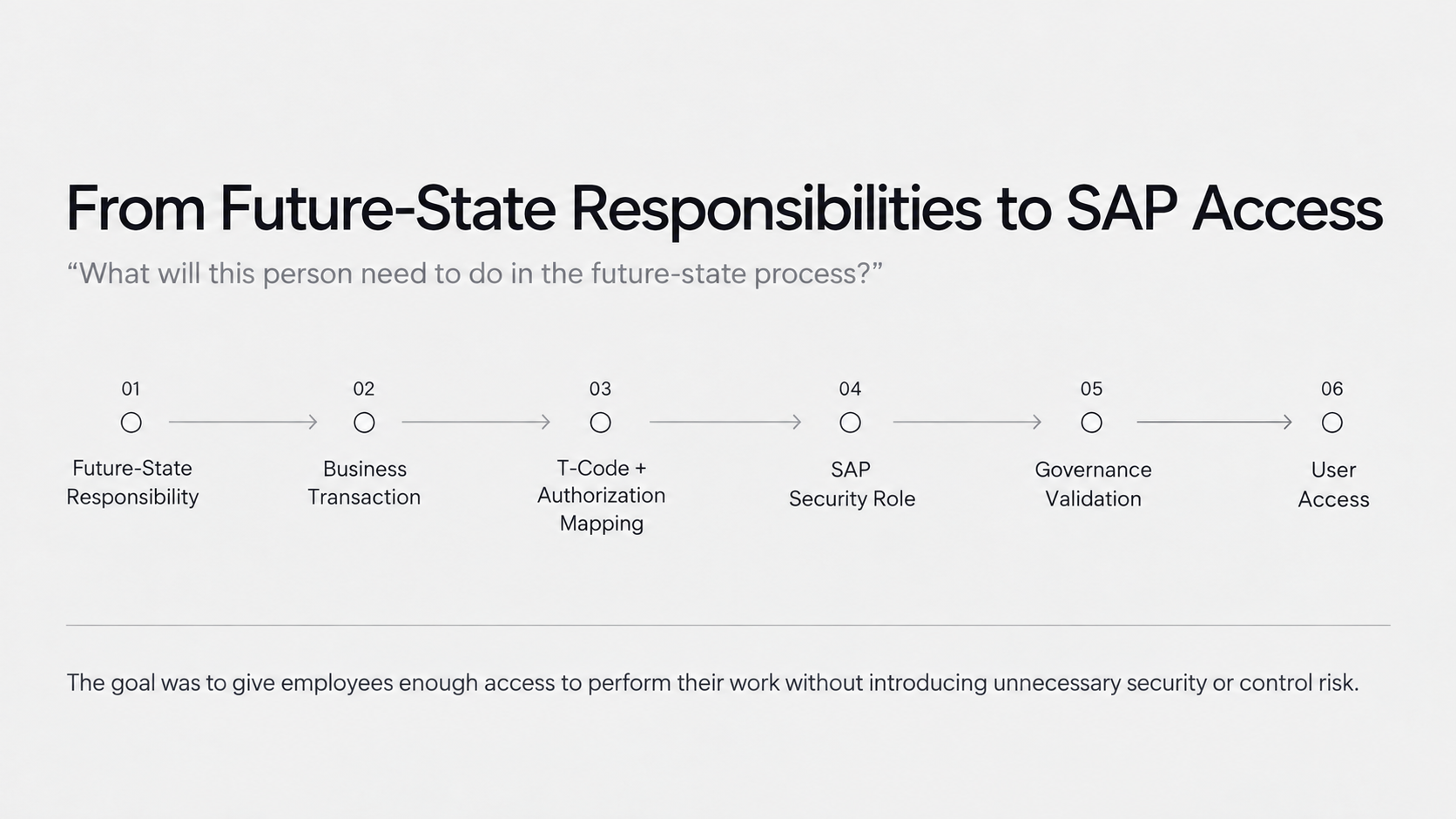
SAP Business and Security Role Design
Translating future-state responsibilities into SAP access required balancing what employees needed to do with the security and governance standards the organization needed to maintain.
I worked with functional leaders and security-governance teams to turn business responsibilities into practical, compliant access within SAP.
My work included
Designed and built SAP business and security roles based on future-state job responsibilities and business processes.
Role Design & Build
Mapped the transactions and permissions employees needed to perform their responsibilities in SAP.
T-Code & Authorization Mapping
Segregation of Duties Analysis
Identified access combinations that created Segregation of Duties conflicts and worked through options for remediation.
Access Exception Management
Managed cases where required business access did not fit the standard role or control model.
Adapted role design to the operating realities of individual locations, particularly smaller sites where staffing levels affected how responsibilities could be separated.
Site-Specific Access Design
Partnered with local and Paris-based Global Security Governance teams to resolve complex access questions and escalate conflicts when needed.
Global Governance Escalation
Helped develop compliant alternatives when clean separation of duties was not operationally possible, including mitigating or compensating controls where appropriate.
Mitigating & Compensating Controls
The goal was to give employees the access they needed to perform the work while preserving the governance and controls required by the business.
When Clean Separation of Duties Wasn't Operationally Possible
The challenge
Global governance standards required certain responsibilities to remain separate.
At some smaller locations, however, there simply were not enough employees to divide those responsibilities across multiple people.
So the question became:
How do we preserve the intent of the control while enabling employees to do the work they are accountable for?
My approach
-
Understand the work
Determine which transactions the employee genuinely needed.
-
Identify the conflict
Analyze the SoD issue created by the requested access.
-
Evaluate alternatives
Determine whether responsibilities or access could reasonably be separated.
-
Escalate when necessary
Partner with local and Paris-based Global Security Governance.
-
Develop a compliant solution
Use access exceptions, mitigating controls, or compensating controls where appropriate.
The process balanced global security requirements with the operational realities of smaller manufacturing locations, allowing employees to perform necessary work while maintaining appropriate governance and controls.
Using the organization's experience instead of starting from scratch
I connected with teams in other markets that had already implemented SAP to understand what they had learned about role design, T-code access, Segregation of Duties, and security governance. Those conversations helped inform decisions in the North American implementation and provided an opportunity to apply lessons that had already emerged elsewhere in the transformation.
Prior Global Implementations
Lessons learned role design SoD approaches access practices
North American Implementation
Global Security Governance
Helping Employees Make the Move to SAP
The employees involved were not simply moving from one SAP environment to another. Many were transitioning from different ERP systems into SAP.
That meant even basic navigation represented a new way of working.
What I built
SAP Basic Navigation
An introductory learning experience designed to orient employees to the SAP environment.
Hands-On Navigation Workshops
Guided practice that gave employees an opportunity to navigate the system rather than only watch a demonstration.
SAP Navigation Practice Lab
Designed for guided practice, not passive demonstration.
Build familiarity and confidence navigating the SAP environment before moving into role-specific work.
-
Get oriented
Explore the SAP environment and become familiar with the basic navigation structure.
-
Find a transaction
Practice locating the transaction or activity needed for the task.
-
Move through the system
Practice navigating between screens while maintaining orientation within the workflow.
-
Follow a guided activity
Complete a facilitator-led navigation exercise with prompts and support.
-
Try it independently
Repeat the navigation task with less guidance to build confidence before role-specific training.
Before moving on
- What feels clear?
- Where would additional practice be helpful?
Representative reconstruction for portfolio purposes. Content has been simplified and sanitized to illustrate the learning approach without reproducing proprietary materials.
Enabling the transformation to continue when in-person delivery was no longer possible
The transformation had relied heavily on project teams traveling to facilities to deliver communications, workshops, change activities, and training in person. When travel and site access stopped, the challenge was not simply moving meetings online. The team needed to quickly build the capability to communicate, facilitate, and engage employees effectively in a virtual environment.
I developed practical guidance and training to help project team members make that transition, with a focus on the facilitation skills and platform features that supported participation rather than passive attendance.
The enablement included:
Productive virtual meeting practices
Screen sharing and shared control
Chat and participant engagement techniques
Annotation and collaborative meeting features
Facilitation techniques for maintaining interaction remotely
Live practice sessions for members of the project team
In-person delivery
Site visits Workshops Communications Training
Delivery model disrupted
which led toVirtual facilitation capability
Engagement Collaboration Shared control Interactive facilitation
The objective was not simply to teach a virtual meeting tool. It was to help the transformation team continue facilitating meaningful communication, collaboration, and learning when the existing delivery model was no longer available.
From Strategy to Local Execution
Global Direction
Understand the transformation strategy and objectives.
Business Requirements
Translate future-state responsibilities into what employees needed to do.
Governed System Access
Build roles and resolve access and SoD requirements.
Capability Building
Prepare employees to navigate and work within SAP.
Local Execution
Support teams and sites as the transformation moved into practice.
Transformation required the strategy, system, governance, and people experience to work together.
My role and contribution
Business Change Manager, Global Transformation Team
My role sat at the intersection of change, governance, access design, and learning. I helped translate transformation requirements into practical solutions that employees and sites could actually use, while working within global security and governance standards.
Directly led / owned
- SAP business and security role design
- T-code and authorization mapping
- SoD analysis and remediation
- Access exception management and governance escalation
- Site-specific access solutions
- Global and local stakeholder coordination
- SAP navigation learning
- Hands-on SAP practice workshops
- Virtual facilitation enablement
Partnered with
- Paris-based Central Transformation Team
- Global Security Governance
- Local security and governance stakeholders
- Functional leaders
- Change managers
- Project managers
- Site teams
- SAP implementation teams in other global markets
The work required connecting global standards with local operating realities while keeping system governance and employee readiness in view.
Lessons that shaped my approach
Designed and built SAP business and security roles based on future-state job responsibilities and business processes.
01 Start with the work
02 Governance has to work in the real world
Standards matter, but applying them effectively sometimes requires understanding local operating realities and designing appropriate controls.
03 Global transformation works both ways
Strategy flows from the center, but lessons, constraints, and insights from individual implementations also need to flow back into the broader program.
04 Adoption requires both access and capability
Giving someone system access does not mean they are ready to use the system. People also need understanding, practice, and support.